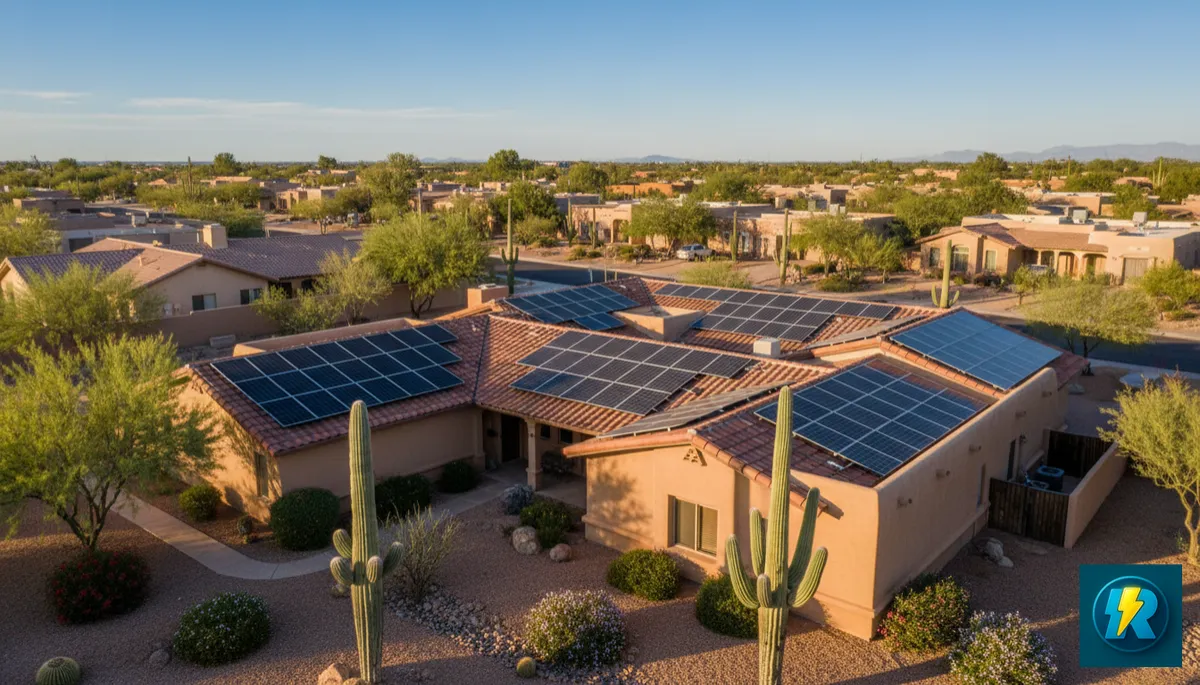
Tucson gets more than 286 sunny days a year, and for the past decade solar companies have worked hard to put panels on as many rooftops as possible. Thousands of homeowners said yes. Now many of those same homeowners are ready to sell — and they're finding out that a solar system is not a simple fixture that conveys like a light switch or a dishwasher.
It might be. Or it might be a leased system that requires buyer credit approval from a third-party company. Or a financed system with a UCC-1 fixture filing that appears in the title search. Or a PACE loan that eliminates FHA and VA buyers from your pool entirely.
Before you list your Tucson home, know exactly what's on your roof and how it's financed. Everything else in the transaction flows from that answer.
The Four Solar Arrangements — and What Each Means at Closing
1. Owned Outright (Fully Paid)
If you bought your panels with cash or paid off your solar loan in full, the system conveys with the house like any other permanent fixture — no monthly obligation, no lien, no third-party approval required. An owned, well-documented system can also help your appraisal. Gather your installer contract, building permits, utility interconnection agreement, and at least 12 months of inverter production data to support the appraiser's adjustment.
2. Solar Loan (Financed System)
Two issues come up at closing.
UCC-1 fixture filings. Solar loans often include a Uniform Commercial Code financing statement filed against the property in county real property records or with the Arizona Secretary of State. A fixture filing appears in a title search and is treated similarly to a lien. Your buyer's lender will require it to be paid off, released, or subordinated before the loan funds. The release happens on the solar lender's timeline — discover it days before close and you're extending escrow. Before you list, ask your title or escrow company to run a preliminary title search on your own property.
Remaining loan balance. If you still owe money on the solar loan, that balance typically must be satisfied from your sale proceeds at closing, the same way a second mortgage would be paid off.
3. Solar Lease or Power Purchase Agreement (PPA)
With a lease or PPA, a third-party company owns the panels. You pay a fixed monthly fee (lease) or a per-kilowatt-hour rate (PPA) for a 20- to 25-year term, typically with annual escalation clauses. At closing, you have two realistic paths:
- Buyer assumes the lease or PPA. The solar company must approve the buyer — typically including a credit check — and the buyer takes over the remaining term and monthly payment. The Arizona REALTORS Solar Addendum (updated November 2025) establishes specific contingency timelines for this within the purchase contract. The solar company's review typically takes 2–6 weeks. Start it immediately after opening escrow. The monthly lease payment also typically counts in the buyer's debt-to-income ratio, which can reduce what they qualify to borrow.
- Seller buys out the lease. You pay the solar company's buyout amount from your proceeds so the buyer receives an owned system. Buyout figures vary widely by remaining term — get a formal quote before pricing your home, because that number directly affects your actual net.
4. PACE Financing (Property Assessed Clean Energy)
PACE loans finance energy improvements by attaching repayment to your property tax bill as a special assessment that travels with the property. The financing consequences are significant:
- FHA financing: Properties are generally ineligible for FHA-insured mortgages with an outstanding PACE obligation. It must be paid off at or before closing.
- VA financing: Properties with PACE liens are not eligible for VA financing.
- Fannie Mae/Freddie Mac: Fannie Mae will not purchase mortgage loans on properties where a PACE loan carries senior lien priority over the first mortgage.
If your home has PACE financing, your realistic buyers are cash purchasers, those using non-conventional lending, or you pay the balance from your proceeds at closing. Know your payoff amount before you list.
What Arizona Disclosure Law Requires
Arizona sellers must disclose known material facts that affect property value and that a buyer could not discover through a reasonable inspection. That duty comes from Hill v. Jones, 151 Ariz. 81 (App. 1986). For solar specifically:
- The Arizona REALTORS Seller's Property Disclosure Statement (SPDS) asks whether any alternate power system is owned, leased, or financed — and asks you to attach a copy of the lease. The SPDS should go to the buyer within three days of contract acceptance under the standard Arizona resale contract.
- Under A.R.S. §33-422 (the Affidavit of Disclosure for unincorporated county parcels), sellers must identify leased solar devices and provide the leasing company's name and contact information.
- A solar lease, PPA, PACE assessment, or UCC-1-secured loan all materially affect the buyer's financing and title commitment. Disclose the lender or lessor, monthly payment, remaining term, and payoff amount.
Sellers who fail to disclose a leased system or fixture lien face nondisclosure claims long after closing. Attach the full lease to your disclosure package and deliver it early. The Arizona REALTORS Solar Addendum belongs in the contract on day one if solar is part of the deal.
Wondering how your solar obligation compares to what an as-is cash sale requires? Our guide to selling your Tucson house as-is explains how cash buyers handle the process differently.
How Solar Affects Your Buyer's Financing and Appraisal
Appraisal: Only an owned, paid-off system can add appraised value — and only if comparable solar sales exist in your neighborhood. Leased and PPA systems add no appraised value because the buyer doesn't own the equipment.
Underwriting: Any unresolved UCC-1 filing, outstanding solar loan balance, or PACE obligation will stop a conventional, FHA, or VA loan from funding. The monthly lease payment generally counts in the buyer's DTI calculation unless the lease terminates at closing.
TEP export rate lock: Tucson Electric Power moved to a net billing system (replacing traditional net metering) in 2018. Under current Arizona Corporation Commission rules, TEP locks the export credit rate in place at interconnection for 10 years — customers are compensated at the Resource Comparison Proxy (RCP) rate in effect when they applied to interconnect, not the rate in effect when the home sells. A system with an older interconnection date may carry a higher locked export rate than a newer system. Confirm your rate and interconnection date with TEP directly and share that information with buyers — it can be a genuine selling point.
Comparing Your Options: COST + TIME + RISK + ACTUAL NET
| Situation | Cost | Timeline | Risk | Actual Net |
|---|---|---|---|---|
| Owned panels, traditional sale | Normal closing costs | 30–45 days | Low | Best outcome; system may add appraised value |
| Lease/PPA → buyer assumes | Transfer fee (confirm with solar company) | 45–75 days (2–6 wk solar co. review) | Medium — buyer must qualify | May require price adjustment |
| Lease/PPA → seller buyout | Full buyout from proceeds | Standard once payoff confirmed | Low for deal; significant cost | Reduced; buyer gets owned system |
| PACE loan outstanding | Full PACE balance at closing | Standard | High if balance exceeds equity | Reduced; FHA/VA buyers ineligible |
| Cash sale to direct buyer | No agent commission | 7–21 days | Lowest — no lender requirements | Fastest close; no solar co. approval |
Frequently Asked Questions
Does the solar lease transfer automatically when I sell?
No. The buyer must apply for assumption approval from the solar company, which involves a credit review. If the buyer doesn't qualify, the seller must arrange a buyout or removal before closing. The Arizona REALTORS Solar Addendum sets the timeline for this process in the purchase contract.
Can an Arizona HOA block my buyer from keeping the solar panels?
No. Under A.R.S. §33-1816, Arizona HOAs cannot prohibit the installation or use of a solar energy device. They may impose reasonable placement restrictions, but restrictions that increase installation costs or decrease efficiency by more than 20% are not enforceable.
My solar installer went out of business. How do I handle the lease or lien?
If your installer or lessor is no longer operating, the lease or loan may have been sold to a third party. Run a UCC lien search through the Arizona Secretary of State and Pima County records to identify the current lienholder. Your title company can help you find who to contact for a payoff, transfer, or release before closing.
Do I need to disclose the UCC-1 filing from my solar loan?
Yes. Any encumbrance on title — including a UCC-1 fixture filing for a solar loan — is a material fact you must disclose. A title company will find it regardless. Disclose it early and provide the payoff details so buyers aren't surprised in escrow.
Can I still sell quickly with a leased system?
Yes, but a traditional listed sale with a financed buyer adds the solar company's approval timeline to your escrow. A cash buyer who doesn't require lender approval eliminates that bottleneck entirely. Read our guide to selling your Tucson house fast for a full comparison of timelines and trade-offs.
Rapid Close Realty Can Help — Solar Situation and All
At Rapid Close Realty, we work with Tucson homeowners who have solar complications regularly. Whether your system is owned, leased, financed with a UCC filing, or carrying a PACE balance, we can help you understand your options — without requiring you to resolve every complication before you get an offer.
If you want to skip the solar company approval process, the transfer paperwork, and the waiting, a direct cash offer may be your cleanest path to closing. We buy Tucson homes in any condition and with solar systems in any financing state. Have general questions about how we work? Visit our FAQ page.
Contact Rapid Close Realty today for a no-obligation cash offer on your Tucson home →