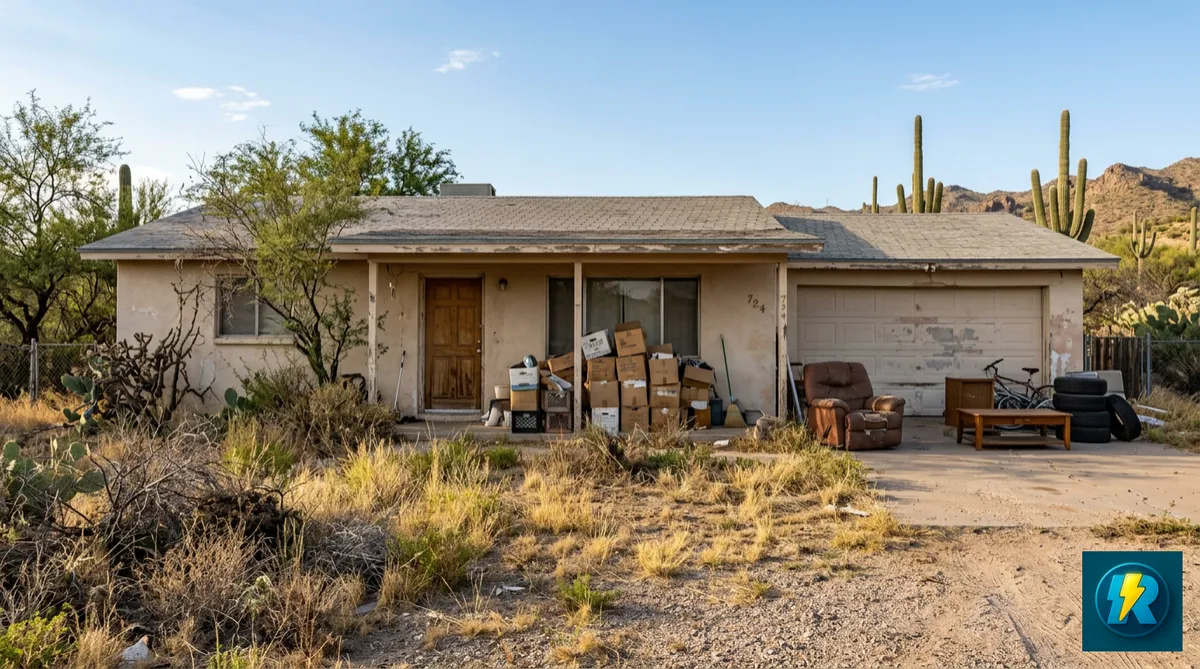
How to Sell a Hoarder House in Arizona: Your Realistic Options (2026)
You inherited a relative's home — and it hasn't been entered in years. Or you've been living with a hoarding situation for a long time and the property has become unmanageable. Either way, the house is packed, and you're wondering whether you need to spend thousands on cleanup before anyone will even look at it.
The short answer: no, you don't have to clean it out first. Selling a hoarder house in Arizona — including in Tucson and the surrounding Pima County area — does not require a full cleanout before you can sell. But it does come with real considerations: what Arizona law requires you to disclose, what code enforcement can do, and which sale path gives you the best actual outcome when all costs are counted.
This guide walks through all of it.
What Makes a Hoarder Property Different to Sell
A severely cluttered home creates several challenges that a typical fixer-upper doesn't:
- Lenders won't finance it. FHA, VA, and most conventional lenders require properties to meet minimum condition standards before approving a mortgage. In severe hoarding situations, the property won't appraise and won't qualify — which limits your buyer pool to cash-only purchasers from the start.
- Inspections are limited. When a home is packed from floor to ceiling, inspectors often can't access walls, floors, plumbing, or electrical systems. That creates uncertainty buyers and their lenders won't accept.
- Secondary damage is common. Extended hoarding situations frequently involve pest infestations, mold, structural damage from deferred maintenance, or — in animal hoarding cases — biohazard contamination. These aren't cosmetic problems; they're material defects with legal implications for sellers.
- The emotional weight is real. Many hoarder houses involve a loved one's lifetime of belongings. The decisions about what to keep, donate, or discard require time and emotional energy that is completely separate from the real estate process itself.
What Arizona Law Requires You to Disclose
Arizona does not have a single statute that lists every item sellers must disclose. Instead, the rule was established by Arizona courts: a seller must disclose known facts that materially affect the value of the property and that a buyer could not reasonably discover on their own. This standard — established in Hill v. Jones, 151 Ariz. 81, 725 P.2d 1115 (Ct. App. 1986) — is enforced through the Arizona REALTORS® Seller's Property Disclosure Statement (SPDS), and the seller's warranty survives closing.
Here's what that means for a hoarding situation:
- Pest infestations caused or worsened by hoarding conditions are disclosable material defects.
- Structural damage to floors, walls, or the roof that occurred while the property was in this condition must be disclosed if you know about it.
- Mold resulting from the property condition is a required disclosure.
- Biohazard contamination — common in animal hoarding situations — is a physical condition that materially affects value and must be disclosed.
- Active code enforcement notices you have received are facts a buyer would reasonably want to know and should appear on the SPDS.
One critical clarification: selling "as-is" in Arizona does not waive your disclosure obligations. An as-is sale means you won't be making repairs — not that you're exempt from disclosing what you know. Arizona courts have consistently held that as-is clauses do not shield sellers from liability for non-disclosure of known material defects. Keep your signed SPDS and supporting documents for at least six years; fraud-based real estate claims in Arizona carry a three-year statute of limitations under A.R.S. § 12-543, which begins running when the buyer discovers the undisclosed problem — not at closing.
For inherited properties where you've never occupied the home: your disclosure obligation is limited to facts you actually know. You cannot disclose what you are genuinely unaware of. However, Arizona courts recognize the concept of willful blindness — you cannot deliberately avoid learning about a known problem to escape disclosure. A professional inspection before choosing your sale path is both practical and protective.
→ For more on the SPDS and Arizona's disclosure rules: Arizona Seller Disclosure Requirements: What the SPDS Form Covers (2026)
Code Enforcement in Tucson and Pima County
Tucson's Neighborhood Preservation Ordinance — codified in City Code Chapter 16 — gives code enforcement officers authority to cite and abate property conditions that create public nuisances or health and safety hazards. Arizona state law reinforces this through A.R.S. § 13-2917 et seq., which defines public nuisances to include conditions that are injurious to health, offensive to the senses, or that obstruct the free use of surrounding property.
A severe hoarding situation — particularly one with outdoor accumulation visible to neighbors — can generate a Notice of Violation from the City of Tucson's Code Enforcement Division. The typical sequence from there:
- The owner receives a written notice identifying the violation with a compliance deadline.
- If the condition is not corrected within that period, the city may pursue civil infraction proceedings and escalating penalties.
- In some cases, the city can abate the condition itself — contracting cleanup — and place the cost as a lien on the property.
- A recorded violation or lien can cloud title and complicate any closing.
An active code violation doesn't automatically block a sale, but it does need to be addressed — either remediated before closing, or clearly disclosed and factored into the purchase agreement. Experienced cash buyers and their title companies are familiar with navigating these situations; financed buyers typically are not.
→ Related: Selling a House With Code Violations in Tucson, Arizona: Your Options Explained
Do You Have to Clean It Out First?
No. But the choice of whether to clean — and how extensively — directly determines which sale paths are available to you, how long the process takes, and what you'll actually net after all costs are counted.
Here's an honest comparison of your three main options.
Option 1: Full Cleanout, Then a Traditional Listing
What it involves: Hiring professional junk removal (and potentially an estate sale company if items have value), deep cleaning, addressing any uncovered repairs, then listing with a real estate agent.
Cost: Junk removal for a severely hoarded home — particularly if a biohazard element is present — can run into several thousand dollars or significantly more depending on volume and condition. Add ongoing carrying costs during the cleanup and listing period, plus seller's agent commissions that typically run 5–6% of the sale price.
Time: Weeks to months for cleanup, then 30–90+ days on market.
Risk: High upfront investment with no guarantee the property sells at a price that recovers those costs. Structural or pest damage revealed during cleanup can compound costs significantly.
Best for: Properties where hoarding was primarily clutter (no structural damage or biohazard), cleanup is manageable in scope, and the after-cleaned value clearly justifies the investment.
Option 2: As-Is Listing With an Agent (Partial or No Cleanup)
What it involves: Listing the property in current or near-current condition through the MLS, marketing it to investors and cash buyers.
Cost: Agent commissions still apply (typically 5–6%). Minimal cleanup or photography prep may help but isn't required.
Time: Properties in this condition tend to sit longer on the MLS — you're waiting for the right cash buyer to find the listing among all other active properties.
Risk: An extended market time means extended carrying costs and ongoing uncertainty.
Best for: Homeowners who want MLS exposure and have time to wait, where the clutter is moderate enough that a cash buyer might still be competitive after their own cleanup.
Option 3: Sell Directly to a Cash Buyer — No Cleanup Required
What it involves: Contacting a local solutions provider like Rapid Close Realty, receiving an offer based on the property's current condition, and closing on your timeline — often within a few weeks.
Cost: No agent commissions. No cleanup. No repairs. The buyer handles everything after closing.
Time: Typically 7–30 days, depending on your timeline, title status, and whether the property involves a probate or estate situation.
Risk: The gross offer will be lower than retail market value — that's the trade-off for speed, certainty, and eliminating cleanup costs.
Net comparison: When you subtract cleanup costs, carrying costs during a traditional process, agent commissions, and any repair costs uncovered during cleanup from the gross sale price — the actual net difference between a cash offer and a traditional sale is often smaller than it first appears.
Best for: Inherited properties, severe hoarding conditions, active code violations, biohazard situations, or any circumstance where speed and certainty matter more than chasing the highest gross number.
Hidden Costs to Factor Before You Decide
Whichever path you're evaluating, these costs are real and consistently underestimated:
- Carrying costs: Every month the property sits — before listing, during the listing period, and through escrow — you're paying mortgage payments (if any remain), property taxes, homeowner's insurance, and utilities. These accumulate quickly.
- Estate sale coordination: If the property contains items of value — furniture, collectibles, tools, jewelry — an estate sale conducted before cleanout can offset some costs, but it takes coordination and time to execute properly.
- Biohazard remediation: Animal hoarding situations can require specialized professional remediation before the property is safe or habitable for future occupants. This is a distinct and significant cost category beyond standard junk removal.
- Secondary damage discovery: Once contents are removed, damage that was concealed becomes visible. Pest damage, water intrusion, mold, or structural deterioration may surface — and once you have knowledge of it, it becomes a disclosure obligation.
How Rapid Close Realty Can Help
Rapid Close Realty works with Arizona homeowners selling difficult properties — including severe hoarding situations, inherited homes with unknown condition, and properties with active code enforcement issues. We buy homes as-is in their current condition. You don't need to clean anything out, make repairs, or prepare the property in any way.
We make our offer based on what the house is today, not what it could be worth after thousands of dollars of work you may not be able to fund or coordinate. And if a traditional listing actually makes more financial sense for your situation, we'll tell you that too — our goal is to help you make the right decision for your circumstances, not to push a particular outcome.
→ See also: How to Sell Your House Fast in Tucson, AZ (2026 Guide)
→ See also: Mold in Your Tucson Home: What Arizona Sellers Need to Know (2026)
Frequently Asked Questions
Does hoarding have to be disclosed when selling in Arizona?
The hoarding condition itself is not the disclosure item — the physical consequences it created are. Pest infestations, structural damage, mold, biohazard contamination, and any code enforcement notices are material defects that must be disclosed if you have knowledge of them. Selling as-is does not eliminate this obligation.
Can a code enforcement violation prevent me from closing?
Not automatically, but it does need to be addressed. Recorded violations and abatement liens can cloud title, and title companies will flag them before closing. You can either resolve the violation before closing or disclose it and negotiate terms that account for it. An experienced cash buyer is typically better equipped to handle this than a buyer relying on conventional financing.
Will a lender finance a hoarder house in Arizona?
In severe conditions, generally no. FHA and VA loans require properties to meet minimum property condition standards, and conventional appraisers are required to document health and safety conditions. A home that inspectors cannot fully access — or that has visible pest, mold, or structural issues — will typically be flagged or declined by lenders, making cash buyers your realistic market.
What if I inherited the property and don't know its full condition?
Your disclosure obligation is limited to facts you actually know. But Arizona courts have recognized willful blindness as a problem — deliberately avoiding knowledge of a condition does not protect you from disclosure liability. A professional inspection before selecting a sale path is the safest approach both practically and legally.
What happens to all the contents after closing?
In a direct cash sale, this is typically negotiated as part of the offer terms. Many cash buyers — including Rapid Close Realty — will accept the property with contents included, handling disposal after closing. In a traditional sale, you're generally expected to clear the property before the close of escrow unless the parties agree otherwise.
This article provides general information for Arizona homeowners and does not constitute legal, tax, or financial advice. Arizona disclosure requirements, code enforcement procedures, and real estate rules vary by municipality and individual circumstance. Consult a qualified Arizona real estate attorney for guidance specific to your situation.
Ready to talk through your specific situation? Rapid Close Realty works with Tucson and Southern Arizona homeowners in exactly these kinds of circumstances — inherited homes, difficult property conditions, and situations where a traditional sale isn't practical. Reach out for a no-obligation conversation about what makes the most sense for your property.